Wheel/Rail Research and Development in Action
October, 2008
This issue of Interface presents some of the innovative work being done by railroads, researchers and suppliers to integrate technology that improves vehicle/track interaction.
The issue’s lead article on “Assessing the Effects of Coupler Force and Train Speed on Freight Car Curving Resistance,” examines the effect of decreasing track/train and coupler force resistance on curving resistance and, ultimately, fuel consumption on freight railways. The study, performed by Rail Sciences, Inc. (RSI), identified the forces, such as aerodynamic, inertial and grade forces, track deflection and suspension damping, curving resistance, and bearing and wheel/rail friction, that contribute to the resistance encountered by a moving train.
RSI examined inherent conditions, such as grade forces, which cannot be changed, and the primary factors that contribute to curving resistance — energy loss at the wheel/rail contact patch, and energy loss relating to vertical and lateral track deflection — which can be changed. Results of the study indicate that fuel consumption can be reduced, but it comes at a cost.
Rail Cant Measurement
Excessive, unidentified wear also comes at a cost — one that sometimes includes those associated with derailment. Arthur Clouse, Manager, Automated Track Inspection Program, Track and Structures Division in the Federal Railroad Administration Office of Safety, looks at the causes of rail seat abrasion on concrete ties, the industry’s ability to identify and measure the degradation that occurs between the rail and tie, and efforts to develop recommendations and guidance to the industry.
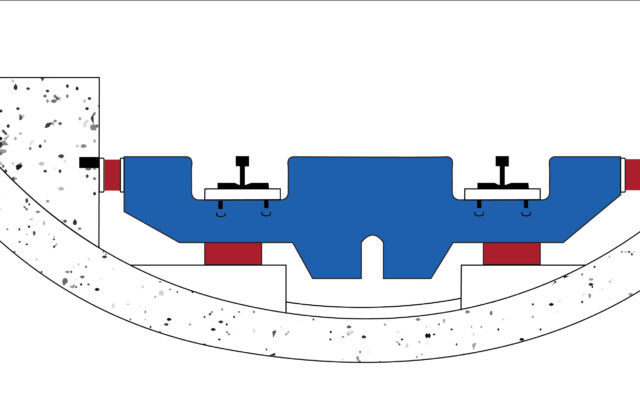
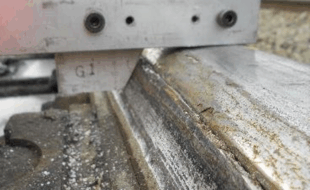
Rail seat abrasion, of course, is not a new phenomenon. Railways have been dealing with it for years. What is new in this context is the effort to apply available technology to help identify it. The industry is now looking at ways to use rail cant measurements, which are provided by the rail profile measurement systems found on many (railbound and hi-rail) track geometry cars, to help identify rail seat abrasion on concrete ties.
Clouse points out in “Rail Cant Measurement of Concrete Crossties” that “deterioration, or abrasion, is the result of a compressive load and/or the mechanical effects of deterioration from repeated, concentrated wheel loading, which typically develops a triangular void on the field side of the tie and allows the rail to tilt or roll outward under load, increasing track gauge.” This is very useful information when you consider that a 1/8-inch void in the rail seat area equates to one degree of inward or outward rail cant.
The article establishes an historical perspective on the issue, which will be further developed in Part 2.
Wheel/Rail Interaction
Part 2 of “Wheel/Rail Interaction ’08: Data to Information,” incorporates information presented at Advanced Rail Management’s 14th annual seminar devoted to wheel/rail interaction. The article provides information on Canadian National’s pilot program to develop and implement a wireless system to monitor the temperature of CWR in order to detect track buckles and rail breaks, and emerging problems that are related to temperature changes, tonnage, track and surfacing work.
The article also looks at the state of the art in target profiles for rail grinding, top-of-rail friction control, efforts to accurately evaluate the risk of wheel climb, and the use of automated systems to monitor the condition of rolling stock and identify vehicles that are most likely to damage rail and the track structure.
As Ryan McWilliams, Vice President of Technology and Business Development at Salient Systems Inc., pointed out: It's important for industry leaders to know the strengths and limits of the available options.
Out-of-Round Wheels
Out-of-round wheels are known to have a significant effect on vehicle and track maintenance costs, and on safety and comfort on passenger systems, as well. But, as Bernhard Barkow and Paul Mittermayr point out in their article on “Identifying Causes of Out-of-Round Wheels: Measuring Field Experience Against Simulations,” the issues are complex, and studies of out-of-round wheels are scarce. The findings presented in this article are based on the use of a simulation tool that models rolling motion under realistic operating conditions. Simulation results, together with field measurements, provide a tool to better predict wheels' lifecycles. The authors caution, however, of the need for frequent, detailed measurements in order to detect emerging problems and accurately predict wheel life and lifecycle costs.
Enjoy the issue.
Bob Tuzik
Publisher
|

"Rail Cant Measurement of Concrete Crossties" (Part 1 of 2)
READ ARTICLE
"Wheel/Rail Interaction ’08: Data to Information"
(Part 2 of 2)
READ ARTICLE
"Assessing the Effects of Coupler Force and Train Speed on Freight Car Curving Resistance"
READ ARTICLE
"Identifying Causes of Out-of-Round Wheels: Measuring Field Experience against Simulations"
READ ARTICLE
Browse Archives
News & Events
|
|

Register to receive free editorial updates and current information from
Interface Journal
CLICK HERE
|
|
|